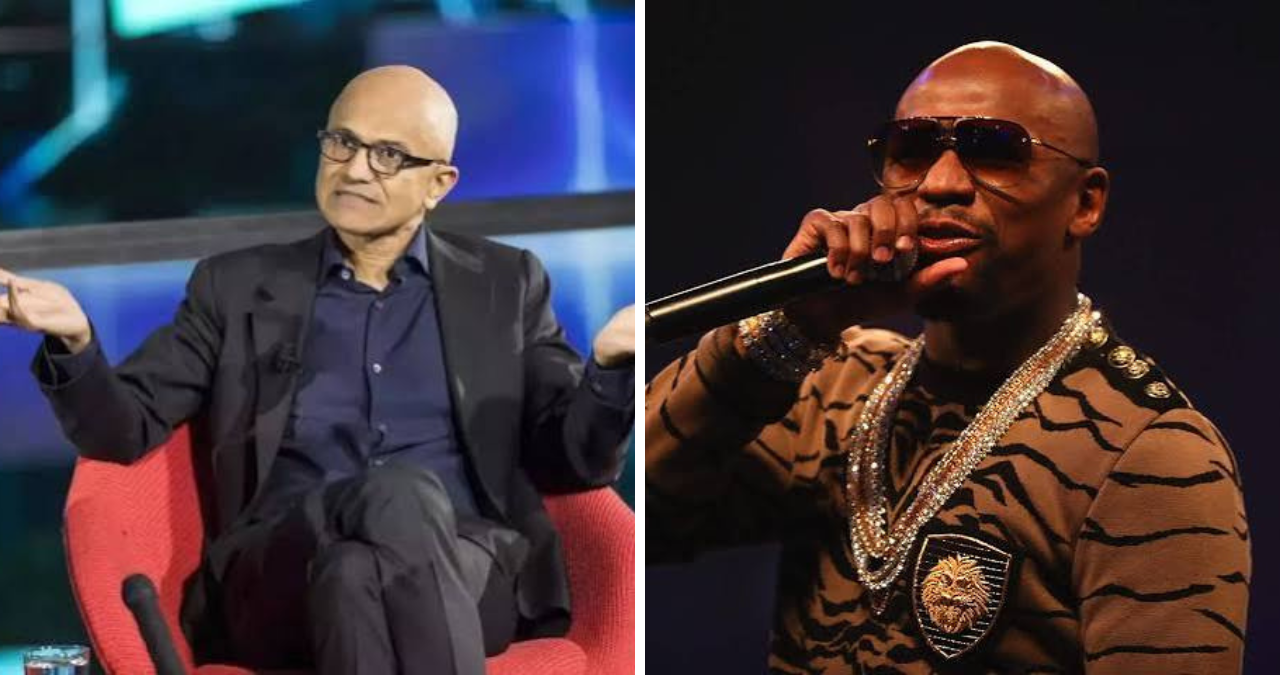
Satya Nadella and Floyd Mayweather are two internationally known figures whose success stories come from very different worlds. Nadella is the Indian-American business executive who became chairman and chief executive officer of Microsoft, while Mayweather is the American boxing icon, promoter, entrepreneur, and undefeated former world champion.
One built his reputation through technology, leadership, cloud computing, artificial intelligence, and corporate transformation. The other built his name through speed, defensive brilliance, world titles, pay-per-view events, personal branding, and business control. Their paths are different, but both demonstrate how discipline, ambition, resilience, strategy, and reinvention can create a global legacy.
Satya Nadella is often viewed as one of the most influential technology leaders of the modern era. He helped Microsoft move beyond its historic dependence on Windows and traditional software by strengthening cloud services, enterprise technology, gaming, developer tools, and artificial intelligence. Under his leadership, Microsoft became one of the world’s most valuable and influential technology companies.
Floyd Mayweather is widely regarded as one of the greatest defensive boxers in history. He retired from professional boxing with a perfect record of 50 wins and no losses. Beyond the ring, he changed how elite fighters could control promotions, negotiate massive purses, build personal brands, and turn individual boxing matches into worldwide entertainment events.
This article explores Satya Nadella and Floyd Mayweather in depth, including their early lives, careers, success stories, net worth journeys, leadership styles, achievements, businesses, personal lives, and lasting influence.
Who Is Satya Nadella?
Satya Narayana Nadella is an Indian-American business executive best known as the chairman and CEO of Microsoft. He became Microsoft’s chief executive officer in February 2014, succeeding Steve Ballmer. In 2021, he also became chairman of Microsoft’s board.
Nadella joined Microsoft in 1992 and spent more than two decades working in several key divisions before becoming CEO. His career inside the company gave him experience in enterprise software, online services, cloud computing, product development, business strategy, and technology leadership.
He is especially known for transforming Microsoft’s culture and business strategy. Before Nadella became CEO, Microsoft was still a powerful company, but many people believed it had become too dependent on Windows and Office. The technology industry was changing rapidly because of smartphones, cloud computing, search engines, social media, data services, mobile apps, and artificial intelligence.
Nadella helped Microsoft adapt to this new era. His leadership focused on cloud platforms, subscription services, enterprise tools, artificial intelligence, cybersecurity, gaming, developer communities, and partnerships. He encouraged Microsoft to become more collaborative, more open to learning, and less defensive toward competitors.
His leadership philosophy is often summarized through the phrase “learn-it-all” rather than “know-it-all.” The idea is that successful companies and individuals must remain curious, open-minded, adaptable, and willing to learn from changing circumstances.
Satya Nadella’s Early Life
Satya Nadella was born on August 19, 1967, in Hyderabad, India. He grew up in a family that valued education, discipline, public service, and intellectual growth.
His father, Bukkapuram Nadella Yugandhar, worked as an Indian Administrative Service officer. His mother, Prabhavati, was a Sanskrit lecturer. This family environment exposed Nadella to education and public responsibility from an early age.
As a child, Nadella was interested in cricket. He has frequently spoken about the lessons he learned from the sport. Cricket taught him teamwork, patience, strategy, decision-making, and the importance of understanding the strengths of others.
These lessons later became part of his management style. Nadella is not known for the aggressive, confrontational approach sometimes associated with major corporate leaders. Instead, he is known for being calm, reflective, collaborative, and focused on helping teams work effectively.
After completing his early education in Hyderabad, Nadella pursued engineering. His interest in technology eventually took him from India to the United States, where he continued his education and started building a career in the technology industry.
Satya Nadella Education
Satya Nadella studied electrical engineering at the Manipal Institute of Technology, which was affiliated with Mangalore University at the time. His engineering education gave him a technical foundation that later helped him understand complex software, cloud infrastructure, computer systems, and emerging technologies.
After completing his degree in India, Nadella moved to the United States. He earned a master’s degree in computer science from the University of Wisconsin–Milwaukee.
He later completed a master of business administration degree from the University of Chicago Booth School of Business. Nadella worked at Microsoft while completing his MBA, often traveling between Seattle and Chicago.
This combination of technical and business education helped shape his career. He understood technology not only as an engineer but also as a business leader who needed to evaluate markets, customers, investments, corporate culture, and long-term strategy.
His education reflects a major theme in his professional life: the ability to combine specialized knowledge with broad thinking. Nadella has never been viewed only as a software engineer or only as a corporate executive. His success comes from understanding how technology, business, people, and society interact.
Satya Nadella Career Before Microsoft
Before joining Microsoft, Satya Nadella worked at Sun Microsystems. At the time, Sun Microsystems was one of the most important technology companies in the world. It was known for computer systems, servers, networking technology, software, and the development of Java.
Working at Sun gave Nadella early experience in enterprise technology. He learned how major organizations use complex computer systems and how technology companies compete in fast-changing markets.
In 1992, Nadella joined Microsoft. At that time, Microsoft was already a major force in personal computing because of Windows, Office, and other software products. However, the company was still growing into the global enterprise and cloud giant it would later become.
Nadella entered Microsoft at an important time. Personal computers were expanding, businesses were increasingly relying on software, the internet was becoming more important, and technology companies were beginning to shape modern work and communication.
His first years at Microsoft helped him understand the company’s culture, systems, business divisions, and long-term possibilities. Over time, he moved into more senior leadership roles and became involved in some of Microsoft’s most important strategic changes.
Satya Nadella’s Rise at Microsoft
Satya Nadella did not become Microsoft CEO immediately. He spent more than 20 years developing experience inside the company. His rise was built through a series of leadership positions in different parts of Microsoft’s business.
He held roles in the Microsoft Business Division, the Online Services Division, and the Server and Tools Business. Each role gave him a different perspective on Microsoft’s products and customers.
One of his most important positions was leading Microsoft’s Cloud and Enterprise division. This role gave him responsibility for major products and services that would become central to the company’s future, including Azure.
Azure is Microsoft’s cloud-computing platform. It allows businesses, governments, developers, and organizations to access computing power, storage, databases, security tools, analytics, artificial intelligence, and software services over the internet.
Cloud computing changed how companies use technology. In the past, organizations often had to purchase and maintain large amounts of hardware and software in their own offices or data centers. Cloud services made it possible to access powerful technology resources more flexibly.
Nadella recognized the potential of cloud technology early. He helped Microsoft shift toward a future where cloud services would become a major source of revenue and a foundation for other products.
This experience made him a strong candidate for CEO when Microsoft began searching for a successor to Steve Ballmer.
Satya Nadella as Microsoft CEO
Satya Nadella became Microsoft CEO in February 2014. When he took over, Microsoft faced several challenges. The company remained extremely successful, but it was also under pressure to prove it could compete in a technology world increasingly shaped by smartphones, cloud platforms, social networks, mobile apps, and new consumer devices.
Microsoft had historically dominated personal-computer software. Windows and Office were used by millions of people around the world. But the industry was changing, and Microsoft needed to become more flexible.
Nadella’s leadership focused on transformation rather than abandoning Microsoft’s past. He kept the company’s strengths in productivity software and enterprise technology while expanding its role in cloud computing, data systems, security, AI, gaming, and software development.
One major cultural change under Nadella was Microsoft’s greater openness to partnerships and outside technologies. Microsoft increasingly supported open-source software, worked more closely with developers, expanded its products across different platforms, and developed stronger relationships with customers that did not rely only on Windows.
For example, Microsoft Office and other services became more accessible across Apple, Android, and web-based platforms. This was an important change because Microsoft was no longer treating Windows as the only center of its business strategy.
Nadella also pushed Microsoft to focus on customer needs. Rather than asking only how to sell more software, the company increasingly asked how technology could help individuals and organizations work more effectively.
Satya Nadella and Microsoft Azure
Microsoft Azure became one of the most important parts of Nadella’s legacy. Azure is a cloud platform used by companies, governments, schools, developers, startups, healthcare organizations, banks, retailers, and many other institutions.
Azure provides cloud infrastructure, data services, artificial intelligence tools, networking, cybersecurity, software-development tools, and enterprise platforms. It allows organizations to build, operate, and scale digital services without having to own every piece of technology infrastructure themselves.
Under Nadella, Microsoft invested heavily in global data centers and cloud services. This helped the company compete with Amazon Web Services and Google Cloud.
The success of Azure also strengthened other Microsoft products. Microsoft 365, Teams, Dynamics, Power Platform, Windows services, developer tools, cybersecurity products, and AI platforms all benefit from the company’s cloud infrastructure.
Microsoft’s cloud strategy helped create more stable recurring revenue. Instead of selling software only once, the company increasingly offered subscription-based and service-based products. This business model created ongoing relationships with customers and made Microsoft less dependent on traditional software licensing.
The transformation was financially significant. Microsoft’s cloud business grew into one of the largest technology operations in the world, helping the company reach record levels of revenue, operating income, and market value.
Satya Nadella and Artificial Intelligence
Artificial intelligence became one of the defining themes of Nadella’s leadership. Microsoft has invested heavily in AI research, data centers, cloud capacity, language models, productivity tools, developer services, cybersecurity, and AI assistants.
Nadella understood that AI would not only be a consumer trend. It would reshape business software, enterprise computing, customer service, data analysis, software development, search, healthcare, education, cybersecurity, and workplace productivity.
Microsoft’s AI strategy includes Azure AI services, Copilot tools, enterprise software, developer platforms, and cloud infrastructure. The company has also developed a close partnership with OpenAI, which helped Microsoft integrate advanced generative AI technology into many of its products.
Microsoft Copilot is one of the most visible examples of this strategy. Copilot is designed to help users write documents, summarize information, create presentations, analyze data, write code, search internal knowledge, and complete workplace tasks.
The AI era has created opportunities as well as concerns. AI can improve productivity, but it also raises questions about privacy, cybersecurity, misinformation, bias, jobs, and responsible technology use.
Nadella has consistently emphasized that AI should be developed responsibly. Microsoft has invested in safety principles, governance tools, privacy controls, and enterprise protections as it expands AI products.
Under Nadella, Microsoft has positioned itself as a company that wants to provide not only AI applications but also the infrastructure and tools that allow businesses to use AI safely and at scale.
Satya Nadella’s Leadership Style
Satya Nadella is known for a leadership style built around empathy, learning, teamwork, and curiosity. He is often viewed as quieter and more reflective than many other famous technology executives.
One of the central ideas in his leadership philosophy is empathy. Nadella believes leaders must understand the experiences, needs, and challenges of employees, customers, and communities.
His views on empathy were influenced by his personal life. Nadella and his wife, Anupama Nadella, had three children. Their oldest son, Zain, was born with cerebral palsy and required extensive care. Nadella has spoken about how becoming a parent changed his understanding of other people’s needs and helped him develop deeper empathy.
Zain Nadella died in 2022 at the age of 26. His life and family experience had a lasting influence on Nadella’s thinking about accessibility, inclusion, healthcare, technology, and leadership.
Nadella’s approach to leadership is not based on the idea that a CEO must know every answer. Instead, he believes leaders should create an environment where people feel encouraged to learn, experiment, question assumptions, and improve.
This is why his “learn-it-all” idea became important at Microsoft. A company that believes it already knows everything may become stuck in the past. A company that remains willing to learn can adapt to new challenges.
Satya Nadella’s Major Acquisitions
During Nadella’s time as CEO, Microsoft made several major acquisitions that expanded its influence across technology, business, gaming, and software development.
One of the most important acquisitions was LinkedIn in 2016. Microsoft purchased LinkedIn for approximately $26 billion. LinkedIn gave Microsoft a powerful presence in professional networking, recruiting, online learning, workplace data, and business communication.
The acquisition also made strategic sense because LinkedIn’s professional network connects naturally with Microsoft’s productivity tools. LinkedIn users often rely on Office, Teams, Outlook, Dynamics, and other Microsoft products.
In 2018, Microsoft acquired GitHub. GitHub is one of the world’s most important platforms for software developers. Developers use GitHub to host code, collaborate on projects, share open-source software, and manage technical work.
The GitHub acquisition helped Microsoft improve its relationship with developers and open-source communities. It also showed that Microsoft had become more open and collaborative than it had been in earlier decades.
In 2023, Microsoft completed the acquisition of Activision Blizzard. This deal significantly expanded Microsoft’s gaming business by adding major game franchises and entertainment properties. The acquisition strengthened Microsoft’s position in console gaming, PC gaming, mobile gaming, subscriptions, and digital entertainment.
These acquisitions show that Nadella’s Microsoft is much broader than a traditional software company. It operates across cloud computing, AI, developer tools, gaming, professional networking, cybersecurity, workplace software, and enterprise technology.
Floyd Mayweather Biography
Floyd Joy Mayweather Jr. is an American former professional boxer, boxing promoter, entrepreneur, and public figure. He is widely known as one of the greatest defensive boxers in history and one of the highest-paid athletes of all time.
Mayweather was born on February 24, 1977, in Grand Rapids, Michigan. He comes from a boxing family. His father, Floyd Mayweather Sr., was a professional boxer, and his uncles Roger Mayweather and Jeff Mayweather also competed professionally.
His family background gave him early exposure to the boxing world. He grew up watching fighters train, spar, prepare for bouts, and deal with the pressure of professional competition.
Mayweather faced financial hardship and instability during childhood. Boxing became more than a sport for him. It became a path toward discipline, identity, financial independence, and national recognition.
He began training at a young age and quickly developed the qualities that later made him famous: speed, hand-eye coordination, defensive instincts, balance, footwork, reflexes, and confidence.
Mayweather’s early nickname was “Pretty Boy Floyd.” The name reflected the fact that he often finished fights with few visible marks on his face because opponents had trouble landing clean punches. Later, he became widely known as “Money Mayweather,” a name that represented his enormous financial success and luxury-focused public persona.
Floyd Mayweather’s Amateur Career
Before turning professional, Floyd Mayweather built an impressive amateur record. He won 84 amateur fights and lost only 6. He also won three National Golden Gloves championships.
Mayweather competed at the 1996 Olympic Games in Atlanta, where he won a bronze medal in the featherweight division. His semifinal loss to Bulgarian boxer Serafim Todorov was controversial, with many fans believing Mayweather had done enough to win.
Even though he did not win Olympic gold, the event increased his visibility. Boxing experts saw him as a highly talented prospect with exceptional technical ability.
His amateur career helped him develop discipline and adaptability. Amateur boxing often requires fighters to compete frequently, adjust to different opponents, and perform under strict tournament conditions.
Mayweather’s success as an amateur prepared him for the professional ranks. He entered professional boxing with confidence, skill, family experience, and a strong desire to create a better life.
Floyd Mayweather’s Professional Debut
Floyd Mayweather made his professional boxing debut in 1996. He was still very young, but his talent was immediately visible.
Early in his career, Mayweather was more aggressive than he later became. He scored knockouts, attacked opponents with fast combinations, and displayed impressive offensive power. As his career progressed and he moved into higher weight classes, his style became more defensive and strategic.
In 1998, Mayweather won his first world title when he defeated Genaro Hernández for the WBC super featherweight championship. Hernández was a respected and experienced fighter, so the victory made a strong statement about Mayweather’s potential.
Mayweather continued winning important fights and gradually moved through multiple weight divisions. His ability to succeed against bigger opponents became a major part of his legacy.
He won world championships in five different weight classes and captured titles at super featherweight, lightweight, light welterweight, welterweight, and light middleweight.
His success across divisions proved that he was not just a talented boxer at one weight. He could adapt to different levels of size, strength, power, and competition.
Floyd Mayweather’s Greatest Fights
Floyd Mayweather fought many elite opponents during his professional career. His record includes victories over world champions, knockout artists, highly skilled boxers, and major pay-per-view attractions.
One of his early defining wins came against Diego Corrales in 2001. Corrales was undefeated and considered a dangerous puncher. Mayweather dominated the fight, knocking Corrales down multiple times before the bout was stopped.
His fights with José Luis Castillo were important because Castillo gave him one of the toughest challenges of his career. Mayweather won both fights, although the first decision was debated by some fans.
In 2005, Mayweather defeated Arturo Gatti in a dominant performance. Gatti was a popular fighter known for action-packed bouts, but Mayweather’s speed and precision made the difference.
The 2007 fight against Oscar De La Hoya changed Mayweather’s career financially and culturally. De La Hoya was one of boxing’s biggest stars. Mayweather won by split decision, but the event itself was massive. It became one of the biggest pay-per-view boxing events of its time.
Later in 2007, Mayweather defeated Ricky Hatton. In 2009, he returned from retirement to beat Juan Manuel Márquez. In 2010, he defeated Shane Mosley, another respected champion.
Mayweather also defeated Miguel Cotto, Canelo Álvarez, Marcos Maidana, Manny Pacquiao, Andre Berto, and Conor McGregor.
His 2013 victory over Canelo Álvarez was especially important because Canelo was younger, larger, and expected by many fans to be a major challenge. Mayweather controlled the fight through timing, movement, defense, and accuracy.
The 2015 fight against Manny Pacquiao was one of the most anticipated boxing matches in history. After years of negotiations and public debate, Mayweather and Pacquiao finally met in Las Vegas. Mayweather won by unanimous decision.
In 2017, Mayweather fought UFC star Conor McGregor in a crossover boxing match. The event attracted enormous worldwide attention. Mayweather won by technical knockout in the tenth round, earning his 50th professional victory.
Floyd Mayweather’s Undefeated Record
Floyd Mayweather retired from professional boxing with a record of 50 wins, no losses, and 27 victories by knockout.
The 50–0 record is one of the most important parts of his legacy. Boxing is a difficult sport in which fighters often face injuries, changing styles, age, weight differences, and dangerous opponents. Remaining undefeated through a long career is rare.
Mayweather’s supporters argue that his record proves he was one of the greatest fighters in history. He defeated champions across multiple divisions and consistently found ways to win, even when fights were difficult.
Critics sometimes argue that he carefully selected opponents or did not always fight them at their absolute peak. However, this argument applies to many great fighters because boxing negotiations, weight classes, promoter conflicts, injuries, and television contracts all influence when fights happen.
What is clear is that Mayweather fought a long list of respected opponents and never lost a professional match.
His 50–0 record also gave him a powerful marketing advantage. Every fight became connected to the question of whether anyone could finally defeat him. This made his bouts feel like major events.
Floyd Mayweather Boxing Style
Floyd Mayweather is famous for his defense. Many boxing historians and analysts consider him one of the most technically advanced defensive fighters ever.
His style relied on movement, timing, footwork, reflexes, shoulder defense, counterpunching, accuracy, and ring intelligence. Rather than simply absorbing punches, Mayweather made opponents miss.
One of his best-known techniques was the shoulder roll, also called the Philly shell. In this defensive position, he used his lead shoulder to protect his chin while keeping his hands ready to block and counter.
Mayweather had the ability to make opponents frustrated. Fighters would throw punches, miss, and become more aggressive. When they overextended themselves, Mayweather often countered with a clean right hand or sharp left hook.
He was also highly intelligent inside the ring. He studied opponents carefully, identified weaknesses, adjusted during fights, and used different strategies depending on the opponent.
Early in his career, he was faster and more aggressive. As he grew older and fought at higher weights, he became more conservative and defensive. This adaptation helped him extend his career and reduce unnecessary damage.
Some fans preferred more aggressive fighters who exchange punches frequently. However, Mayweather’s supporters appreciated his ability to control fights while taking very little punishment.
Floyd Mayweather as a Promoter
Floyd Mayweather’s business success is as important as his athletic success. He did not simply become a champion; he learned how to control the business around his fights.
After leaving Top Rank, Mayweather created Mayweather Promotions. This decision gave him more influence over fight promotion, event planning, negotiations, marketing, ticket sales, sponsorships, and pay-per-view revenue.
In boxing, fighters can earn large purses, but promoters and broadcasters can also receive major shares of the money generated by events. By becoming his own promoter, Mayweather increased his control over the value he created.
He also became highly skilled at promoting himself. His “Money Mayweather” persona emphasized wealth, success, luxury cars, private jets, expensive watches, gambling, and extravagant lifestyle choices.
Some people admired this image, while others criticized it. But it was highly effective from a marketing perspective. Mayweather understood that people would pay to watch him win, but many would also pay to watch him lose.
By becoming a polarizing figure, he created strong emotional investment around his fights. Fans either supported him or wanted to see an opponent defeat him. Both groups helped drive interest and revenue.
Differences Between Satya Nadella and Floyd Mayweather
The biggest difference between Satya Nadella and Floyd Mayweather is their industry. Nadella operates in global technology, corporate leadership, cloud infrastructure, artificial intelligence, software, and enterprise business.
Mayweather built his career in combat sports, entertainment, boxing promotion, pay-per-view events, and personal branding.
Nadella’s work involves leading thousands of employees, building products, making acquisitions, serving enterprise clients, working with investors, and shaping the culture of a major corporation.
Mayweather’s career centered on individual athletic competition. In the boxing ring, his success depended on physical conditioning, tactical judgment, technical skill, courage, and the ability to perform under extreme pressure.
Their public personalities are also different. Nadella is usually seen as calm, thoughtful, private, and focused on technology and leadership. Mayweather is known for being outspoken, flashy, confident, provocative, and highly visible.
Nadella is associated with empathy, learning, teamwork, and long-term transformation. Mayweather is associated with competition, self-belief, financial independence, athletic excellence, and personal brand power.
Neither approach is automatically better. Their careers show that success can take different forms depending on a person’s field, strengths, personality, and goals.
Lessons From Satya Nadella and Floyd Mayweather
Satya Nadella’s story teaches the importance of lifelong learning. He did not remain limited to one technical skill or one department. He continued learning about technology, customers, business strategy, culture, and leadership.
His career also shows that empathy can be a business strength. Understanding people’s needs can improve products, services, relationships, and workplace culture.
Nadella’s leadership demonstrates that established companies must keep evolving. Microsoft had already achieved enormous success before he became CEO, but he recognized that past success would not guarantee future relevance.
Floyd Mayweather’s story teaches the importance of preparation. His undefeated record was built through years of training, discipline, studying opponents, and maintaining confidence.
His career also shows the value of financial control. Mayweather understood that athletes should learn how their industry works and seek a fair share of the value they create.
Another lesson from Mayweather is the power of branding. Whether people admired or disliked his “Money Mayweather” image, it was memorable. He created an identity that made people pay attention.
Together, Nadella and Mayweather show that long-term success usually requires more than raw talent. It requires discipline, planning, adaptability, self-awareness, and a willingness to make difficult decisions.
Frequently Asked Questions
Who is Satya Nadella?
Satya Nadella is the chairman and chief executive officer of Microsoft. He became CEO in 2014 and has led the company’s transformation in cloud computing, artificial intelligence, enterprise technology, software, and gaming.
What is Satya Nadella famous for?
Satya Nadella is famous for helping Microsoft become a major cloud and AI company. He is also known for promoting empathy, learning, collaboration, and cultural change inside Microsoft.
Where was Satya Nadella born?
Satya Nadella was born in Hyderabad, India.
What is Satya Nadella’s educational background?
He studied electrical engineering in India, earned a master’s degree in computer science from the University of Wisconsin–Milwaukee, and completed an MBA from the University of Chicago Booth School of Business.
Who is Floyd Mayweather?
Floyd Mayweather Jr. is an American former professional boxer, boxing promoter, and entrepreneur. He is known for retiring undefeated with a professional record of 50 wins and no losses.
What is Floyd Mayweather’s boxing record?
Floyd Mayweather’s official professional boxing record is 50 wins, 0 losses, and 27 wins by knockout.
Why is Floyd Mayweather called “Money”?
He is called “Money Mayweather” because of his status as one of the highest-paid athletes in sports history and his luxury-focused personal brand.
Conclusion
Satya Nadella and Floyd Mayweather built their success in entirely different ways, but both became defining figures in their industries.
Nadella helped transform Microsoft from a company strongly associated with Windows and traditional software into a global leader in cloud computing, artificial intelligence, enterprise technology, gaming, cybersecurity, and digital work.
Mayweather became a boxing legend through technical skill, defensive mastery, mental toughness, world championships, business intelligence, and an undefeated professional record.
Their stories show that success is not limited to one personality type or one career path. Nadella represents thoughtful leadership, innovation, empathy, and strategic transformation. Mayweather represents confidence, competitive greatness, preparation, self-promotion, and financial control.
For readers searching for information about Satya Nadella and Floyd Mayweather, the key point is simple: both men turned exceptional ability into lasting influence by understanding not only their craft, but also the larger systems around it.